Videos
”More>>”

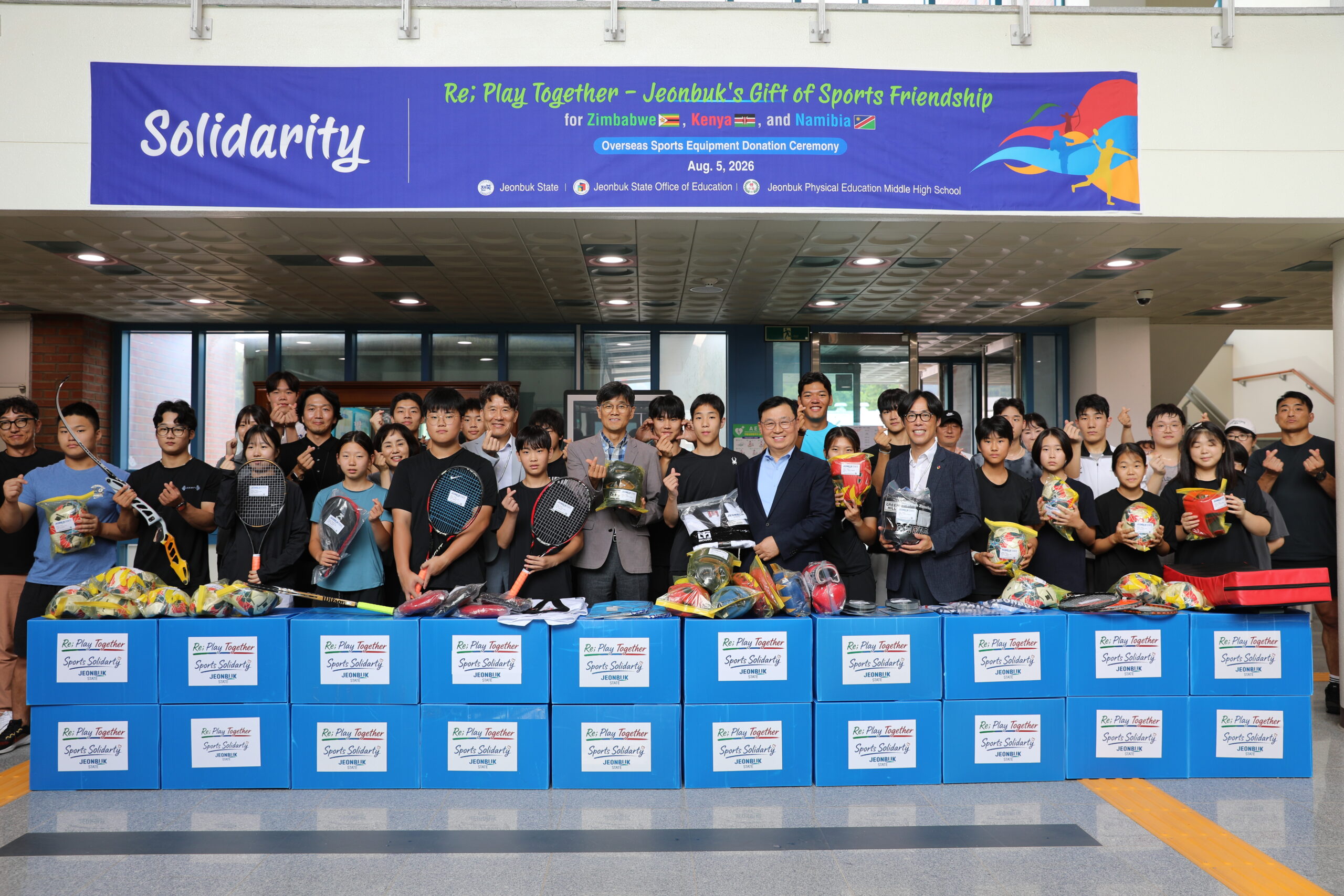
Jeonbuk State, in collaboration with the Jeonbuk State Office of Education and Jeonbuk Physicl Education Middle & High School, is continuing international exchange and friendship through sports by delivering sports equipment donated by students to youth in three African nations. On the 5th, the State and the Office of Education held a send-off ceremony at Jeonbuk Sports Middle & High School for the project titled “Re; Play Together, Jeonbuk Sports Friendship Gifts,” shipping the items to Zimbabwe, Kenya, and Namibia. The theme, ‘Re; Play Together,’ signifies resuming games (Re; Play) that had been halted due to a shortage of soccer balls and sports gear, this time together with Jeonbuk.

This initiative goes beyond mere material support; it aims to practice solidarity and friendship across borders through sports and to expand the foundation for exchange among future generations. In particular, sharing equipment that students actually used spreads the value of sharing while extending Jeonbuk’s international sports diplomacy into schools and the local community. The project originated from visits last year by officials from Zimbabwe and Namibia, with whom Jeonbuk has maintained international sports exchanges. During their visit to Jeonbuk Sports Middle & High School, they requested support for sports equipment. Students readily agreed to contribute, leading to a broader international exchange program supported by the State, the Office of Education, and the school. The donated items total 616 pieces across 12 sports, including soccer, taekwondo, shooting, archery, swimming, etc. —comprising both gear previously used by students and new items collected for this project. The equipment will be delivered to the Ministry of Sport, Recreation, Arts and Culture and National Olympic Committees of each country via Zimbabwean diplomatic missions and international shipping. It will then be distributed to young athletes and youth active in organizations such as the Kirsty Coventry Academy in Zimbabwe, the Waitaka Taekwondo Club in Kenya, and the MTC Hopsol Youth Soccer League in Namibia.

Kim Jong-phil, Director General of Jeonbuk State’s 2036 Summer Olympics Bid Department, stated: “I hope the precious sports items that nurtured the dreams of our Jeonbuk students will serve as a new source of hope for African youth. Moving forward, we will continue to promote international exchange through sports, guided by the International Olympic Committee’s (IOC) core values of inclusion and solidarity.” Im Young-gun, Director of Arts, Physical Ed & Health Division at the Jeonbuk State Office of Education, said, “It was a meaningful opportunity for our students to put into practice the spirit of sportsmanship through sharing and caring while developing a global perspective. We hope that the students’ small but heartfelt gesture will be warmly received by young people in Africa.”

Meanwhile, Jeonbuk State has been steadily expanding its international sports network by dispatching a Taekwondo demonstration team to the World Taekwondo U-21 Championship in Kenya, participating in the World Union of Olympic Cities General Assembly, and broadening sports exchanges with African nations. Starting with the “Sports Friendship Gift” pilot project, Jeonbuk State plans to consider expanding the countries and sports covered by the initiative, while also promoting the hosting of international sporting events and exchange programs inviting young athletes from overseas, with the goal of developing Jeonbuk into a specialized international sports city.

Events
”More>>”
Journalists on the podium
”More>>”
Advertisement
Young Reporter’s corner
”More>>”

AFC Women’s Asian Cup Australia 2026™ Final Draw: All you need to know

July 28, 2025: In just one day, the route to ultimate glory will be determined for the 12 teams bound for the AFC Women’s Asian Cup Australia 2026™.With Sydney set to crown the champions on March 21, 2026, the Harbour City serves as a fitting backdrop for the Final Draw on July 29 (Tuesday), as Australia gears up to stage the Continental showpiece from March 1. As anticipation builds ahead of the draw, the AFC takes a closer look at all the key details that will shape the next chapter in Asian women’s football.

Iconic backdrop

Situated in the heart of the city, the Sydney Town Hall will provide a distinguished setting for the Final Draw.One of the grandest civic buildings in Australia, the stunning 19th-century venue has stood for over 130 years as a landmark of architectural heritage. Renowned for its high Victorian interiors and ornate detailing, it remains among the nation’s most iconic public venues.The grandeur of the Sydney Town Hall offers a fitting stage for one of the key milestones ahead of the AFC Women’s Asian Cup™, reflecting both the tournament’s prestige and Australia’s longstanding commitment to the women’s game.

The final 12

Eight teams booked their tickets to the 21st edition after an intense Qualifiers that took place from June 23 to July 19.

Bangladesh, Chinese Taipei, DPR Korea, India, Islamic Republic of Iran, Philippines, Uzbekistan and Vietnam joined hosts Australia, alongside the top three finishers from the AFC Women’s Asian Cup India 2022™ – defending champions China PR, runners-up Korea Republic, and third-placed Japan, who all earned automatic qualification.

With the hosts guaranteed the top seed, the rest of the seedings—based on the latest FIFA Women’s World Ranking (as of June 12)—and the corresponding pot allocations for the Final Draw are as follows:

Pot 1: Australia (15), Japan (7), DPR Korea (9)
Pot 2: China PR (17), Korea Republic (21), Vietnam (37)
Pot 3: Philippines (41), Chinese Taipei (42), Uzbekistan (51)
Pot 4: IR Iran (68), India (70), Bangladesh (128)

Stunning venues

Australia will feature in the opening match at the Perth Stadium on March 1, while the ultimate showdown for the coveted trophy will take place at Sydney’s Stadium Australia on March 21.

The splendour of the tournament will be on full display across three cities and five different stadiums.

Games in Sydney will take place in Stadium Australia as well as the Western Sydney Stadium, while Perth will also have two venues i.e. the Perth Rectangular Stadium and Perth Stadium; the fifth venue is the Gold Coast Stadium.

Local spotlights

Adding to the festive mood, each host city will stage watch parties that will livestream the Final Draw for invited guests, enhancing local engagement, and bringing the excitement of the Continental contest closer to home.

While the Sydney Town Hall will be the seat of all the action, the Cumberland Lounge at Western Sydney Stadium will host the watch party, led by Sydney-based emcee Lavendar Baj.

At the same time, in the Gold Coast, guests will gather at HOTA Cinema, where beloved comedian and TV personality Alex Ward will take on hosting duties.

Finally, over in Perth, the QT Hotel Rooftop will welcome attendees, including members of local government, with renowned presenter Lauren Markham hosting the evening’s proceedings.

Eye on the prize

Twenty years after first hosting the showpiece, Australia will once again welcome the cream of the crop in Asia women’s football.

The 2006 edition, which was the first to feature a separate qualification process as well as the name rebrand to AFC Women’s Asian Cup™, set the stage for the success of the flagship in subsequent years. The Matildas fell to China PR after a penalty shootout in the Final and will be raring to go all the way this time on home soil. If that happens, it would make them the fourth host country to lift the trophy after Chinese Taipei (1977), Thailand (1983) and China PR (1997).

Glory will not come easy. Defending champions China PR – the only team to have never finished outside the top four, with a top-three placing in 14 of 15 editions – will aim to claim a record 10th crown. Japan, the 2011 FIFA Women’s World Cup champions, are making their 18th Finals appearance and 16th in a row – both records. DPR Korea and Korea Republic will also fancy their chances, while Vietnam, Philippines and Chinese Taipei cannot be underestimated.

A very welcome return beckons for both India and Uzbekistan, who last took part in 2003, while the Islamic Republic of Iran made it consecutive qualifications after their Finals debut in 2022. And then there is the remarkable story of Bangladesh who, having failed to register either a goal or point in two prior qualifying campaigns, pulled off an astounding success earlier this month to earn their maiden Finals involvement.

The top two teams from each group and the two best third-placed sides will advance to the quarter-finals. The four semi-finalists will book their tickets to the FIFA Women’s World Cup Brazil 2027, while the losing sides from the quarter-finals will advance to the playoffs, where two more spots at the global showpiece will be at stake.

Special guests

A trio of draw assistants will be present to add lustre to the evening’s proceedings, as they lend a helping hand to the draw conductor onstage.

Part of the team that claimed a historic first AFC Women’s Asian Cup™ title in 2010, Matildas icon Tameka Yallop is a natural fit to represent the host nation. The 34-year-old has appeared at four other editions, in addition to featuring at four FIFA Women’s World Cups and three Olympic Games. A cornerstone of the Australia midfield with 14 goals in 134 caps, Yallop has spent time in the top leagues of the United States, Germany, Japan, Sweden, Norway and England. Currently in a third stint at Brisbane Roar FC, she sits second in both the A-League Women’s all-time appearance and scoring charts.

India’s return to the AFC Women’s Asian Cup™ owed a great deal to Sangita Basfore, whose brace in their final Qualifier sealed a ninth appearance and first since 2003. The 29-year-old East Bengal star had already netted in each of their previous two matches but saved the best for last on her 70th cap. Since making her debut in 2016, the dynamic midfielder has become a leader for the Blue Tigresses and won two SAFF Championships and two South Asian Games gold medals. Basfore, who took up football at 10, is now their fourth-most capped player and will relish the prospect of her first Finals participation.

A regular for Korea Republic from the U14 level, Jeon Yu-gyeong rose to wider prominence at the AFC U20 Women’s Asian Cup™ last year with four goals to finish as joint-top scorer. The forward continued as captain in their subsequent FIFA U-20 Women’s World Cup campaign and the Uiduk University graduate found her way to Europe earlier this year. Following a short spell at Swiss side Grasshopper Club, the 21-year-old signed for Molde FK in March and is currently the Norwegian outfit’s top scorer as they push for top-flight promotion. Jeon’s status as one of Asia’s rising stars was further underlined with a senior Taeguk Ladies debut in June and she will hope to play a part in their Australia 2026 campaign.

Partners
Advertisement

AFC Women’s Asian Cup Australia 2026™ Final Draw: All you need to know

July 28, 2025: In just one day, the route to ultimate glory will be determined for the 12 teams bound for the AFC Women’s Asian Cup Australia 2026™.With Sydney set to crown the champions on March 21, 2026, the Harbour City serves as a fitting backdrop for the Final Draw on July 29 (Tuesday), as Australia gears up to stage the Continental showpiece from March 1. As anticipation builds ahead of the draw, the AFC takes a closer look at all the key details that will shape the next chapter in Asian women’s football.

Iconic backdrop

Situated in the heart of the city, the Sydney Town Hall will provide a distinguished setting for the Final Draw.One of the grandest civic buildings in Australia, the stunning 19th-century venue has stood for over 130 years as a landmark of architectural heritage. Renowned for its high Victorian interiors and ornate detailing, it remains among the nation’s most iconic public venues.The grandeur of the Sydney Town Hall offers a fitting stage for one of the key milestones ahead of the AFC Women’s Asian Cup™, reflecting both the tournament’s prestige and Australia’s longstanding commitment to the women’s game.

The final 12

Eight teams booked their tickets to the 21st edition after an intense Qualifiers that took place from June 23 to July 19.

Bangladesh, Chinese Taipei, DPR Korea, India, Islamic Republic of Iran, Philippines, Uzbekistan and Vietnam joined hosts Australia, alongside the top three finishers from the AFC Women’s Asian Cup India 2022™ – defending champions China PR, runners-up Korea Republic, and third-placed Japan, who all earned automatic qualification.

With the hosts guaranteed the top seed, the rest of the seedings—based on the latest FIFA Women’s World Ranking (as of June 12)—and the corresponding pot allocations for the Final Draw are as follows:

Pot 1: Australia (15), Japan (7), DPR Korea (9)
Pot 2: China PR (17), Korea Republic (21), Vietnam (37)
Pot 3: Philippines (41), Chinese Taipei (42), Uzbekistan (51)
Pot 4: IR Iran (68), India (70), Bangladesh (128)

Stunning venues

Australia will feature in the opening match at the Perth Stadium on March 1, while the ultimate showdown for the coveted trophy will take place at Sydney’s Stadium Australia on March 21.

The splendour of the tournament will be on full display across three cities and five different stadiums.

Games in Sydney will take place in Stadium Australia as well as the Western Sydney Stadium, while Perth will also have two venues i.e. the Perth Rectangular Stadium and Perth Stadium; the fifth venue is the Gold Coast Stadium.

Local spotlights

Adding to the festive mood, each host city will stage watch parties that will livestream the Final Draw for invited guests, enhancing local engagement, and bringing the excitement of the Continental contest closer to home.

While the Sydney Town Hall will be the seat of all the action, the Cumberland Lounge at Western Sydney Stadium will host the watch party, led by Sydney-based emcee Lavendar Baj.

At the same time, in the Gold Coast, guests will gather at HOTA Cinema, where beloved comedian and TV personality Alex Ward will take on hosting duties.

Finally, over in Perth, the QT Hotel Rooftop will welcome attendees, including members of local government, with renowned presenter Lauren Markham hosting the evening’s proceedings.

Eye on the prize

Twenty years after first hosting the showpiece, Australia will once again welcome the cream of the crop in Asia women’s football.

The 2006 edition, which was the first to feature a separate qualification process as well as the name rebrand to AFC Women’s Asian Cup™, set the stage for the success of the flagship in subsequent years. The Matildas fell to China PR after a penalty shootout in the Final and will be raring to go all the way this time on home soil. If that happens, it would make them the fourth host country to lift the trophy after Chinese Taipei (1977), Thailand (1983) and China PR (1997).

Glory will not come easy. Defending champions China PR – the only team to have never finished outside the top four, with a top-three placing in 14 of 15 editions – will aim to claim a record 10th crown. Japan, the 2011 FIFA Women’s World Cup champions, are making their 18th Finals appearance and 16th in a row – both records. DPR Korea and Korea Republic will also fancy their chances, while Vietnam, Philippines and Chinese Taipei cannot be underestimated.

A very welcome return beckons for both India and Uzbekistan, who last took part in 2003, while the Islamic Republic of Iran made it consecutive qualifications after their Finals debut in 2022. And then there is the remarkable story of Bangladesh who, having failed to register either a goal or point in two prior qualifying campaigns, pulled off an astounding success earlier this month to earn their maiden Finals involvement.

The top two teams from each group and the two best third-placed sides will advance to the quarter-finals. The four semi-finalists will book their tickets to the FIFA Women’s World Cup Brazil 2027, while the losing sides from the quarter-finals will advance to the playoffs, where two more spots at the global showpiece will be at stake.

Special guests

A trio of draw assistants will be present to add lustre to the evening’s proceedings, as they lend a helping hand to the draw conductor onstage.

Part of the team that claimed a historic first AFC Women’s Asian Cup™ title in 2010, Matildas icon Tameka Yallop is a natural fit to represent the host nation. The 34-year-old has appeared at four other editions, in addition to featuring at four FIFA Women’s World Cups and three Olympic Games. A cornerstone of the Australia midfield with 14 goals in 134 caps, Yallop has spent time in the top leagues of the United States, Germany, Japan, Sweden, Norway and England. Currently in a third stint at Brisbane Roar FC, she sits second in both the A-League Women’s all-time appearance and scoring charts.

India’s return to the AFC Women’s Asian Cup™ owed a great deal to Sangita Basfore, whose brace in their final Qualifier sealed a ninth appearance and first since 2003. The 29-year-old East Bengal star had already netted in each of their previous two matches but saved the best for last on her 70th cap. Since making her debut in 2016, the dynamic midfielder has become a leader for the Blue Tigresses and won two SAFF Championships and two South Asian Games gold medals. Basfore, who took up football at 10, is now their fourth-most capped player and will relish the prospect of her first Finals participation.

A regular for Korea Republic from the U14 level, Jeon Yu-gyeong rose to wider prominence at the AFC U20 Women’s Asian Cup™ last year with four goals to finish as joint-top scorer. The forward continued as captain in their subsequent FIFA U-20 Women’s World Cup campaign and the Uiduk University graduate found her way to Europe earlier this year. Following a short spell at Swiss side Grasshopper Club, the 21-year-old signed for Molde FK in March and is currently the Norwegian outfit’s top scorer as they push for top-flight promotion. Jeon’s status as one of Asia’s rising stars was further underlined with a senior Taeguk Ladies debut in June and she will hope to play a part in their Australia 2026 campaign.

Videos
”More>>”

Jeonbuk State, in collaboration with the Jeonbuk State Office of Education and Jeonbuk Physicl Education Middle & High School, is continuing international exchange and friendship through sports by delivering sports equipment donated by students to youth in three African nations. On the 5th, the State and the Office of Education held a send-off ceremony at Jeonbuk Sports Middle & High School for the project titled “Re; Play Together, Jeonbuk Sports Friendship Gifts,” shipping the items to Zimbabwe, Kenya, and Namibia. The theme, ‘Re; Play Together,’ signifies resuming games (Re; Play) that had been halted due to a shortage of soccer balls and sports gear, this time together with Jeonbuk.

This initiative goes beyond mere material support; it aims to practice solidarity and friendship across borders through sports and to expand the foundation for exchange among future generations. In particular, sharing equipment that students actually used spreads the value of sharing while extending Jeonbuk’s international sports diplomacy into schools and the local community. The project originated from visits last year by officials from Zimbabwe and Namibia, with whom Jeonbuk has maintained international sports exchanges. During their visit to Jeonbuk Sports Middle & High School, they requested support for sports equipment. Students readily agreed to contribute, leading to a broader international exchange program supported by the State, the Office of Education, and the school. The donated items total 616 pieces across 12 sports, including soccer, taekwondo, shooting, archery, swimming, etc. —comprising both gear previously used by students and new items collected for this project. The equipment will be delivered to the Ministry of Sport, Recreation, Arts and Culture and National Olympic Committees of each country via Zimbabwean diplomatic missions and international shipping. It will then be distributed to young athletes and youth active in organizations such as the Kirsty Coventry Academy in Zimbabwe, the Waitaka Taekwondo Club in Kenya, and the MTC Hopsol Youth Soccer League in Namibia.

Kim Jong-phil, Director General of Jeonbuk State’s 2036 Summer Olympics Bid Department, stated: “I hope the precious sports items that nurtured the dreams of our Jeonbuk students will serve as a new source of hope for African youth. Moving forward, we will continue to promote international exchange through sports, guided by the International Olympic Committee’s (IOC) core values of inclusion and solidarity.” Im Young-gun, Director of Arts, Physical Ed & Health Division at the Jeonbuk State Office of Education, said, “It was a meaningful opportunity for our students to put into practice the spirit of sportsmanship through sharing and caring while developing a global perspective. We hope that the students’ small but heartfelt gesture will be warmly received by young people in Africa.”

Meanwhile, Jeonbuk State has been steadily expanding its international sports network by dispatching a Taekwondo demonstration team to the World Taekwondo U-21 Championship in Kenya, participating in the World Union of Olympic Cities General Assembly, and broadening sports exchanges with African nations. Starting with the “Sports Friendship Gift” pilot project, Jeonbuk State plans to consider expanding the countries and sports covered by the initiative, while also promoting the hosting of international sporting events and exchange programs inviting young athletes from overseas, with the goal of developing Jeonbuk into a specialized international sports city.

Events
”More>>”
Journalists on the podium
”More>>”
Advertisement
Young Reporter’s corner
”More>>”
Partners
Advertisement

All News

Video Gallery