Publications
”More>>”
Videos
”More>>”

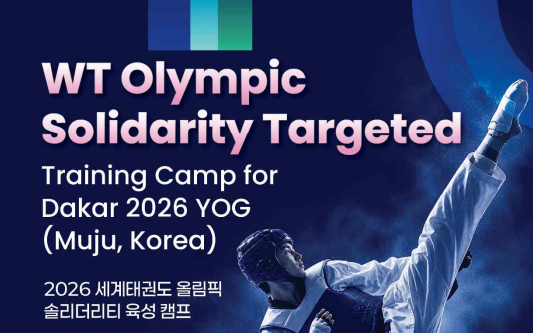
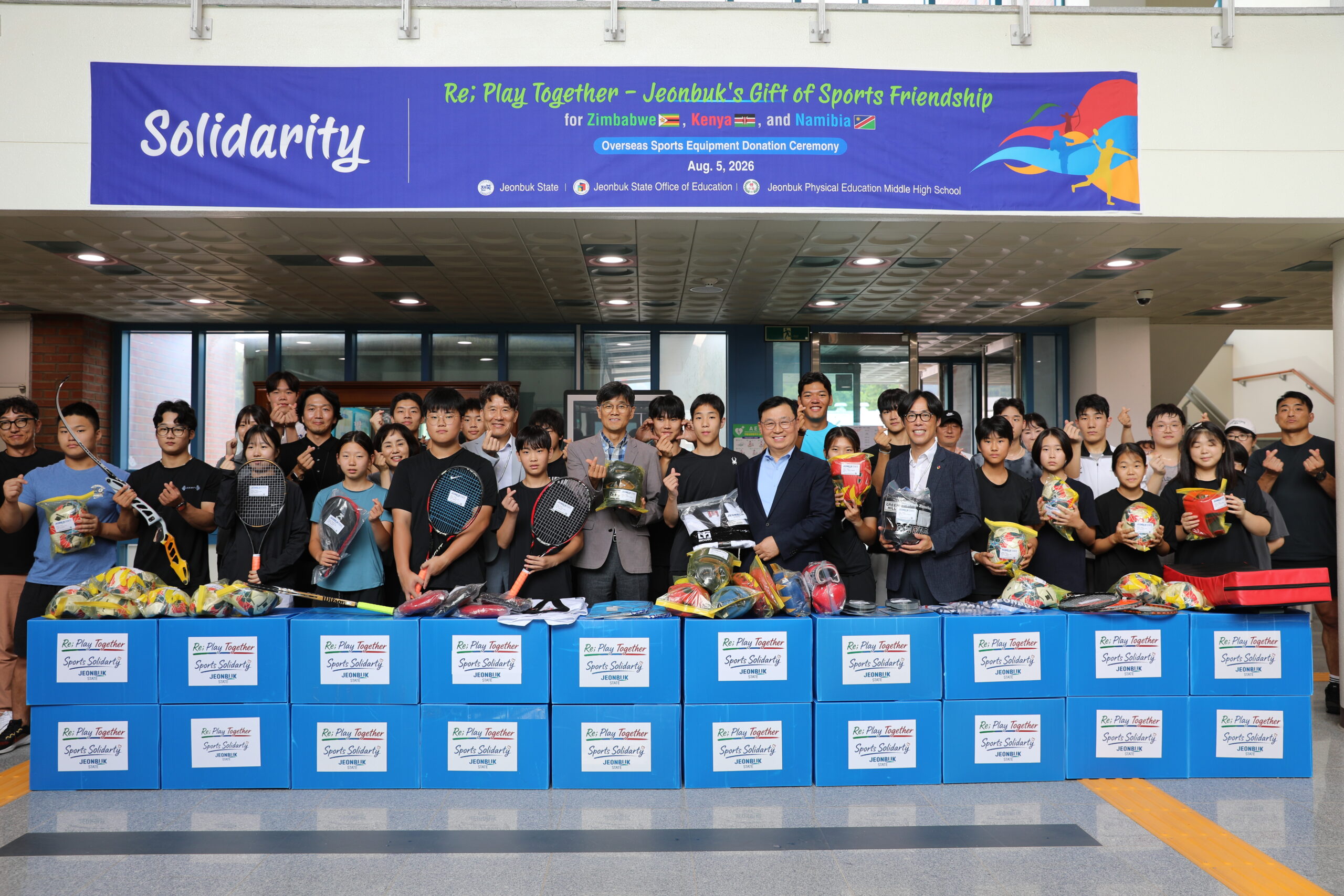
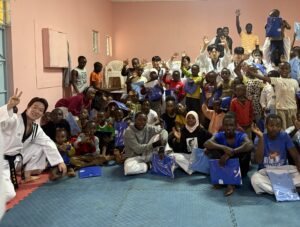
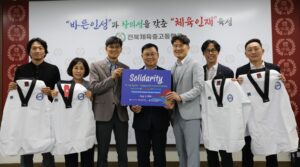
Jeonbuk State, in collaboration with the Jeonbuk State Office of Education and Jeonbuk Physicl Education Middle & High School, is continuing international exchange and friendship through sports by delivering sports equipment donated by students to youth in three African nations. On the 5th, the State and the Office of Education held a send-off ceremony at Jeonbuk Sports Middle & High School for the project titled “Re; Play Together, Jeonbuk Sports Friendship Gifts,” shipping the items to Zimbabwe, Kenya, and Namibia. The theme, ‘Re; Play Together,’ signifies resuming games (Re; Play) that had been halted due to a shortage of soccer balls and sports gear, this time together with Jeonbuk.

This initiative goes beyond mere material support; it aims to practice solidarity and friendship across borders through sports and to expand the foundation for exchange among future generations. In particular, sharing equipment that students actually used spreads the value of sharing while extending Jeonbuk’s international sports diplomacy into schools and the local community. The project originated from visits last year by officials from Zimbabwe and Namibia, with whom Jeonbuk has maintained international sports exchanges. During their visit to Jeonbuk Sports Middle & High School, they requested support for sports equipment. Students readily agreed to contribute, leading to a broader international exchange program supported by the State, the Office of Education, and the school. The donated items total 616 pieces across 12 sports, including soccer, taekwondo, shooting, archery, swimming, etc. —comprising both gear previously used by students and new items collected for this project. The equipment will be delivered to the Ministry of Sport, Recreation, Arts and Culture and National Olympic Committees of each country via Zimbabwean diplomatic missions and international shipping. It will then be distributed to young athletes and youth active in organizations such as the Kirsty Coventry Academy in Zimbabwe, the Waitaka Taekwondo Club in Kenya, and the MTC Hopsol Youth Soccer League in Namibia.
Kim Jong-phil, Director General of Jeonbuk State’s 2036 Summer Olympics Bid Department, stated: “I hope the precious sports items that nurtured the dreams of our Jeonbuk students will serve as a new source of hope for African youth. Moving forward, we will continue to promote international exchange through sports, guided by the International Olympic Committee’s (IOC) core values of inclusion and solidarity.” Im Young-gun, Director of Arts, Physical Ed & Health Division at the Jeonbuk State Office of Education, said, “It was a meaningful opportunity for our students to put into practice the spirit of sportsmanship through sharing and caring while developing a global perspective. We hope that the students’ small but heartfelt gesture will be warmly received by young people in Africa.”

Meanwhile, Jeonbuk State has been steadily expanding its international sports network by dispatching a Taekwondo demonstration team to the World Taekwondo U-21 Championship in Kenya, participating in the World Union of Olympic Cities General Assembly, and broadening sports exchanges with African nations. Starting with the “Sports Friendship Gift” pilot project, Jeonbuk State plans to consider expanding the countries and sports covered by the initiative, while also promoting the hosting of international sporting events and exchange programs inviting young athletes from overseas, with the goal of developing Jeonbuk into a specialized international sports city.
Events
”More>>”
Journalists on the podium
”More>>”
Advertisement
Young Reporter’s corner
”More>>”

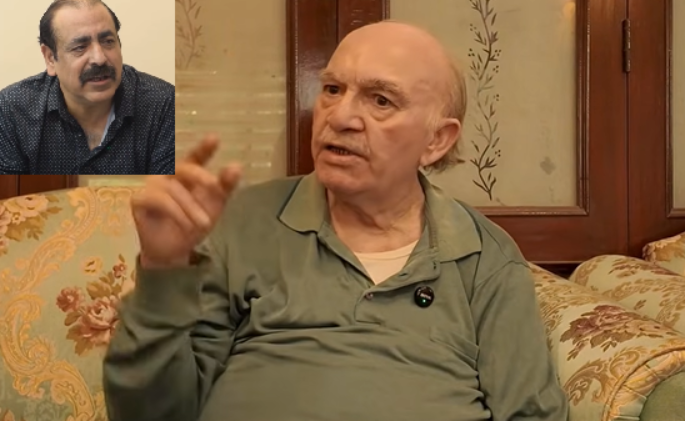
Pakistan’s Shahid Sheikh’s incredible journey in sports journalism

By Asher Butt

Few names in Pakistan’s sports journalism carry the weight of history and experience like Shahid Sheikh, the veteran journalist who has spent more than four decades chronicling the nation’s sporting highs and lows. In a candid conversation with host Syed Ali Raza on Ali Raza Official YouTube channel, Sheikh shared his remarkable journey — from his early days in the 1970s to covering international events in 36 countries, meeting legendary athletes, and witnessing Pakistan’s golden era of hockey and what not.

Early beginnings

Shahid Sheikh’s passion for journalism was nurtured in a family environment steeped in media. His uncle, Sheikh Abdul Rafi Nasim, was a lifelong reporter, and the young Sheikh grew up surrounded by press gatherings and debates. By the mid-1970s, he was already writing for newspapers, with his first reports published in leading dailies without a single edit — a moment that cemented his confidence.

His formal career began in 1981, when he joined Daily Jang Lahore. His first assignment was translating a lengthy report on the World University Games in Moscow, a task he completed with precision. Soon, he was a regular staffer, earning his first salary of Rs. 1,347 per month — a significant sum at the time.

Behind the scenes of cricket’s turbulent era

Sheikh recalled the dramatic 1982 player rebellion against Javed Miandad, when senior cricketers including Majid Khan and Mushtaq Mohammad refused to play under his captaincy. Sheikh was at the heart of the coverage, often chasing late-night exclusives from the homes of Majid Khan and Imran Khan. His reporting during this crisis earned him the trust of editors and eventually the responsibility of overseeing Jang’s daily sports page, weekly color page, and overall sports coverage.

He also spoke of Imran Khan’s rise, noting how Jang Lahore’s coverage played a pivotal role in shaping his image as a national hero. “Imran had leadership qualities, no doubt, but the media’s role in building his stature cannot be ignored,” Sheikh remarked.

Golden era of hockey

Sheikh fondly remembered Pakistan’s dominance in hockey during the 1980s and early 1990s. He covered tournaments where Pakistan was crowned Olympic and Asian Games champion, and later witnessed the revival under foreign coaches in 1994, when Pakistan won the World Cup and Champions Trophy. He believes that modern training, foreign expertise, and league structures — similar to cricket’s PSL — are essential for hockey’s revival today.

Football and sports administration

Turning to football, Sheikh lamented Pakistan’s failure to capitalize on its global popularity. Despite Sialkot manufacturing official FIFA World Cup balls, Pakistan ranks near the bottom in FIFA standings. He attributed this decline to political interference and lack of institutional support, noting that restoring departmental teams like WAPDA and Army could revive the sport.

On sports governance, Sheikh was critical of the Pakistan Sports Board, pointing out that most of its budget is consumed by administration rather than athlete development. He cited the example of javelin star Arshad Nadeem, who rose to prominence only after receiving support from WAPDA and the Army.

International coverage

Sheikh’s career took him across the globe, covering the Asian Games, Olympics, and other international events. He recalled assignments in Korea, Barcelona, and Kuwait, emphasizing that international exposure is vital for journalists to truly understand the dynamics of global sport.

Advice to the next generation

In his closing remarks, Sheikh urged young athletes to focus solely on performance rather than nepotism (sifarish). “There are no shortcuts in sports. Recommendations may help briefly, but only hard work and merit bring lasting success,” he said.

A legacy of integrity and insight

From covering Pakistan’s cricket controversies to celebrating its hockey triumphs, Shahid Sheikh’s journey shows the evolution of sports journalism in Pakistan. His stories offer not just a chronicle of events but a window into the struggles, triumphs, and lessons that continue to shape the nation’s sporting identity. This conversation is a clear enduring relevance of sports journalism in Pakistan, the golden era of hockey, and the future of football administration. Sheikh’s reflections remind us that the role of a journalist is not only to report but to preserve history and inspire future generations.

Partners
Advertisement

Pakistan’s Shahid Sheikh’s incredible journey in sports journalism

By Asher Butt

Few names in Pakistan’s sports journalism carry the weight of history and experience like Shahid Sheikh, the veteran journalist who has spent more than four decades chronicling the nation’s sporting highs and lows. In a candid conversation with host Syed Ali Raza on Ali Raza Official YouTube channel, Sheikh shared his remarkable journey — from his early days in the 1970s to covering international events in 36 countries, meeting legendary athletes, and witnessing Pakistan’s golden era of hockey and what not.

Early beginnings

Shahid Sheikh’s passion for journalism was nurtured in a family environment steeped in media. His uncle, Sheikh Abdul Rafi Nasim, was a lifelong reporter, and the young Sheikh grew up surrounded by press gatherings and debates. By the mid-1970s, he was already writing for newspapers, with his first reports published in leading dailies without a single edit — a moment that cemented his confidence.

His formal career began in 1981, when he joined Daily Jang Lahore. His first assignment was translating a lengthy report on the World University Games in Moscow, a task he completed with precision. Soon, he was a regular staffer, earning his first salary of Rs. 1,347 per month — a significant sum at the time.

Behind the scenes of cricket’s turbulent era

Sheikh recalled the dramatic 1982 player rebellion against Javed Miandad, when senior cricketers including Majid Khan and Mushtaq Mohammad refused to play under his captaincy. Sheikh was at the heart of the coverage, often chasing late-night exclusives from the homes of Majid Khan and Imran Khan. His reporting during this crisis earned him the trust of editors and eventually the responsibility of overseeing Jang’s daily sports page, weekly color page, and overall sports coverage.

He also spoke of Imran Khan’s rise, noting how Jang Lahore’s coverage played a pivotal role in shaping his image as a national hero. “Imran had leadership qualities, no doubt, but the media’s role in building his stature cannot be ignored,” Sheikh remarked.

Golden era of hockey

Sheikh fondly remembered Pakistan’s dominance in hockey during the 1980s and early 1990s. He covered tournaments where Pakistan was crowned Olympic and Asian Games champion, and later witnessed the revival under foreign coaches in 1994, when Pakistan won the World Cup and Champions Trophy. He believes that modern training, foreign expertise, and league structures — similar to cricket’s PSL — are essential for hockey’s revival today.

Football and sports administration

Turning to football, Sheikh lamented Pakistan’s failure to capitalize on its global popularity. Despite Sialkot manufacturing official FIFA World Cup balls, Pakistan ranks near the bottom in FIFA standings. He attributed this decline to political interference and lack of institutional support, noting that restoring departmental teams like WAPDA and Army could revive the sport.

On sports governance, Sheikh was critical of the Pakistan Sports Board, pointing out that most of its budget is consumed by administration rather than athlete development. He cited the example of javelin star Arshad Nadeem, who rose to prominence only after receiving support from WAPDA and the Army.

International coverage

Sheikh’s career took him across the globe, covering the Asian Games, Olympics, and other international events. He recalled assignments in Korea, Barcelona, and Kuwait, emphasizing that international exposure is vital for journalists to truly understand the dynamics of global sport.

Advice to the next generation

In his closing remarks, Sheikh urged young athletes to focus solely on performance rather than nepotism (sifarish). “There are no shortcuts in sports. Recommendations may help briefly, but only hard work and merit bring lasting success,” he said.

A legacy of integrity and insight

From covering Pakistan’s cricket controversies to celebrating its hockey triumphs, Shahid Sheikh’s journey shows the evolution of sports journalism in Pakistan. His stories offer not just a chronicle of events but a window into the struggles, triumphs, and lessons that continue to shape the nation’s sporting identity. This conversation is a clear enduring relevance of sports journalism in Pakistan, the golden era of hockey, and the future of football administration. Sheikh’s reflections remind us that the role of a journalist is not only to report but to preserve history and inspire future generations.

Publications
”More>>”
Videos
”More>>”

Jeonbuk State, in collaboration with the Jeonbuk State Office of Education and Jeonbuk Physicl Education Middle & High School, is continuing international exchange and friendship through sports by delivering sports equipment donated by students to youth in three African nations. On the 5th, the State and the Office of Education held a send-off ceremony at Jeonbuk Sports Middle & High School for the project titled “Re; Play Together, Jeonbuk Sports Friendship Gifts,” shipping the items to Zimbabwe, Kenya, and Namibia. The theme, ‘Re; Play Together,’ signifies resuming games (Re; Play) that had been halted due to a shortage of soccer balls and sports gear, this time together with Jeonbuk.

This initiative goes beyond mere material support; it aims to practice solidarity and friendship across borders through sports and to expand the foundation for exchange among future generations. In particular, sharing equipment that students actually used spreads the value of sharing while extending Jeonbuk’s international sports diplomacy into schools and the local community. The project originated from visits last year by officials from Zimbabwe and Namibia, with whom Jeonbuk has maintained international sports exchanges. During their visit to Jeonbuk Sports Middle & High School, they requested support for sports equipment. Students readily agreed to contribute, leading to a broader international exchange program supported by the State, the Office of Education, and the school. The donated items total 616 pieces across 12 sports, including soccer, taekwondo, shooting, archery, swimming, etc. —comprising both gear previously used by students and new items collected for this project. The equipment will be delivered to the Ministry of Sport, Recreation, Arts and Culture and National Olympic Committees of each country via Zimbabwean diplomatic missions and international shipping. It will then be distributed to young athletes and youth active in organizations such as the Kirsty Coventry Academy in Zimbabwe, the Waitaka Taekwondo Club in Kenya, and the MTC Hopsol Youth Soccer League in Namibia.

Kim Jong-phil, Director General of Jeonbuk State’s 2036 Summer Olympics Bid Department, stated: “I hope the precious sports items that nurtured the dreams of our Jeonbuk students will serve as a new source of hope for African youth. Moving forward, we will continue to promote international exchange through sports, guided by the International Olympic Committee’s (IOC) core values of inclusion and solidarity.” Im Young-gun, Director of Arts, Physical Ed & Health Division at the Jeonbuk State Office of Education, said, “It was a meaningful opportunity for our students to put into practice the spirit of sportsmanship through sharing and caring while developing a global perspective. We hope that the students’ small but heartfelt gesture will be warmly received by young people in Africa.”

Meanwhile, Jeonbuk State has been steadily expanding its international sports network by dispatching a Taekwondo demonstration team to the World Taekwondo U-21 Championship in Kenya, participating in the World Union of Olympic Cities General Assembly, and broadening sports exchanges with African nations. Starting with the “Sports Friendship Gift” pilot project, Jeonbuk State plans to consider expanding the countries and sports covered by the initiative, while also promoting the hosting of international sporting events and exchange programs inviting young athletes from overseas, with the goal of developing Jeonbuk into a specialized international sports city.

Events
”More>>”
Journalists on the podium
”More>>”
Advertisement
Young Reporter’s corner
”More>>”
Partners
Advertisement

All News

Video Gallery